Why You Keep Getting Cavities
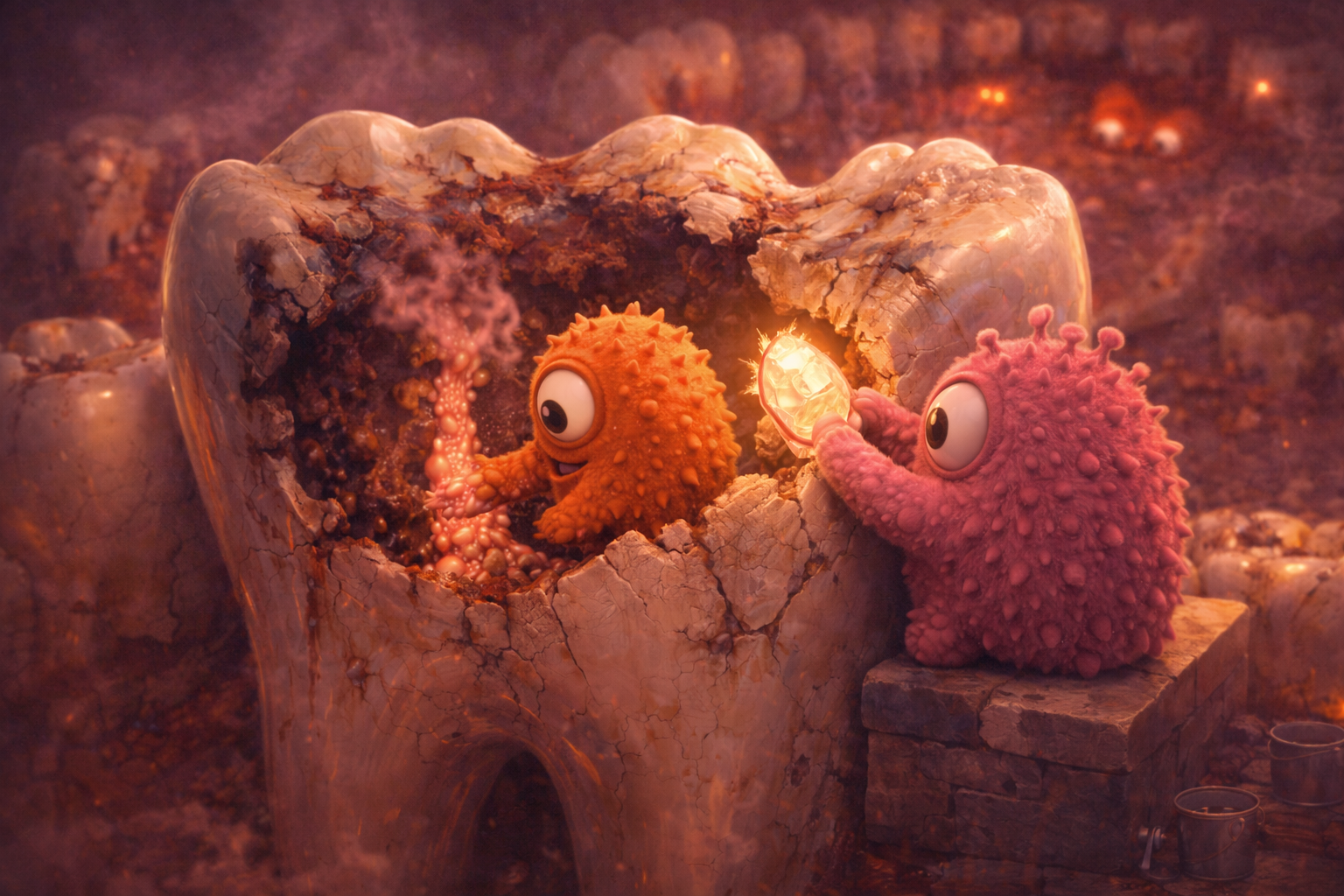
And it is not because you are not brushing enough.
Quick Summary
If you brush twice a day, floss, and still walk out of the dental office with another cavity, you have probably been told to try harder. Brush longer. Floss more. Cut back on sweets.
Here is the part nobody explains. Cavities are not caused by a lack of effort. They are caused by a shift in the environment inside your mouth. When the conditions change, the wrong residents take over, the surface of your teeth starts to dissolve, and no amount of extra scrubbing fixes a problem that is ecological at its core.
Mouth City Was Never Meant to Be Acidic
Most of the time, the city runs in a state of quiet equilibrium.
Your enamel is constantly losing tiny amounts of mineral and gaining it back. Minerals leave the surface, saliva delivers calcium and phosphate to put them back. As long as the two stay balanced, your teeth stay solid. This back and forth never stops. It is happening right now.
The residents that dominate a healthy mouth are mild. They produce only small, infrequent amounts of acid, and the city absorbs it without trouble.
A cavity does not start with a bad bacterium. It starts with a change in the weather.
Scientific Context
Enamel exists in a continuous demineralization and remineralization balance. On a clinically healthy tooth surface, the biofilm is dominated by non-mutans streptococci and Actinomyces species that produce only mild, infrequent acidification. This is described as the dynamic stability stage, where the mineral balance holds steady or even shifts toward net gain (Takahashi and Nyvad, Journal of Dental Research, 2011).
Sugar Is Not the Villain. Frequency Is.
Here is the detail that reframes everything.
It is not the amount of sugar that drives cavities. It is how often the city gets exposed to it.
Every time you eat or drink something fermentable, the bacteria in your biofilm produce acid, and the pH in the city drops. Below a certain point, your enamel starts to dissolve. Then saliva goes to work, neutralizes the acid, and the pH climbs back up so remineralization can resume.
One exposure is a brief storm the city recovers from. The problem is the all-day drizzle. The coffee with creamer at nine. The granola bar at eleven. The soda at one. The handful of crackers at three. Each one resets the clock and keeps the city underwater.
Your enamel can survive almost any single exposure. What it cannot survive is never being allowed to dry out.
Scientific Context
Enamel begins to demineralize when biofilm pH drops below the critical threshold of roughly 5.5. Frequent intake of fermentable carbohydrates produces repeated acid challenges that outpace saliva's ability to buffer and remineralize, tilting the balance toward net mineral loss (Featherstone, Australian Dental Journal, 2008).

The cavity process is slow and mostly invisible. By the time you can see it, the damage has been building for a long time.
When the City Turns Acidic, the Wrong Residents Take Over
This is where a cavity stops being about a single bad day and becomes a pattern.
When the environment stays acidic, the gentle residents that kept the city balanced cannot survive. The conditions favor a different crowd, bacteria that thrive in acid and produce even more of it. As they take over, the city tips into what we call dysbiosis. The same shift we describe across this whole series.
Notice what happened here. The bacteria did not invade from the outside. The environment changed, and that change selected for the residents that make cavities worse. This is why blaming one bug, like the famous Streptococcus mutans, misses the point. It is not one villain. It is a neighborhood that went acidic and attracted the wrong tenants.
Cavities are not an infection you caught. They are an ecosystem that shifted.
Scientific Context
The extended caries ecological hypothesis describes caries as a three-stage, environmentally driven process. Persistent low pH selects for acid-tolerant, acid-producing species and suppresses the non-mutans community that maintains stability, moving the biofilm from a dynamic stability stage through an acidogenic stage to an aciduric stage. Streptococcus mutans is one contributor among many, not a sole cause (Takahashi and Nyvad, Caries Research, 2008).
When the same problem keeps coming back, the question is rarely what did I do wrong this time. The better question is what in my environment keeps allowing this.
Why Brushing Harder Was Never the Answer
So why does the standard advice fail so many people?
Because brushing and flossing remove biofilm from a moment in time. They do not change the conditions that keep rebuilding the wrong biofilm. If your environment stays acidic, the same dysbiotic community reassembles within hours, no matter how diligent you were.
This is also why some people get cavities while eating less sugar than a friend who never does. Their environment is different. Less saliva, lower buffering capacity, more frequent acid exposure, a biofilm already shifted toward acid producers. Same effort, different city.
Saliva is the most underrated piece of this entire story. It buffers acid, delivers minerals, and clears food. When saliva is reduced, by medications, mouth breathing, dehydration, or stress, the city loses its public works system and demineralization wins by default. We went deep on this in Why Saliva Matters More Than You Think.
You cannot scrub your way out of a problem that lives in the environment, not on the surface.
What Actually Changes the Outcome
If cavities are an environment problem, then the solution is to change the environment.
That means moving the conversation away from willpower and toward biology. A few of the levers that actually matter:
- Frequency, not just quantity. Cluster fermentable foods into meals and give the city long stretches to recover and remineralize between them.
- Protect and support saliva. Address dry mouth, mouth breathing, and dehydration, because saliva is the single biggest defense your city has.
- Know your starting point. You cannot manage a microbial environment you have never measured. This is the gap salivary testing fills.
At The Mouth Lab, we think biology first. Instead of telling someone to simply brush more, we look at what is actually growing in their mouth, what the pH environment looks like, and why the conditions keep favoring decay. A salivary microbiome test gives you that picture, and from there the plan stops being a guess.
We can shift an acidic, dysbiotic environment back toward balance using targeted approaches like probiotics, pH support, and protocols built around what the testing actually shows. Not by asking you to try harder at a routine that was never going to address the real problem.

Change the conditions, and the city repairs itself. The biology was never working against you.
See what is actually driving your cavities.
Our Oral Microbiome Test shows you the residents, the balance, and the conditions inside your mouth, with a full interpretation included.
Order Your TestA Question Worth Asking
The next time you are told you have another cavity, try a different question than what did I do wrong.
Ask what in my mouth keeps making this happen. Because if the answer is an environment that keeps tipping acidic, then no amount of extra brushing was ever going to be the fix. The fix is understanding the biology and changing the conditions.
That is a question worth answering with data, not guilt.
The Takeaway
- Cavities are not caused by poor effort. They are caused by an environment that turns and stays acidic.
- It is the frequency of acid exposure, not the total amount of sugar, that drives decay.
- A persistently acidic mouth selects for acid loving bacteria, which is dysbiosis, not a single infection.
- Brushing and flossing remove biofilm but do not change the underlying conditions that rebuild it.
- Saliva is your city's most important defense, and protecting it matters more than most people realize.
- The way out is to measure and shift the environment, not to try harder at the same routine.
For Clinicians
The ecological model of caries has strong support in the literature and reframes recurrent decay as a microbial and environmental management problem rather than a hygiene compliance problem. The extended caries ecological hypothesis (Takahashi and Nyvad) describes caries as a reversible, stage-based process driven by frequency of acid challenge and the resulting selection of aciduric, acidogenic species, with Streptococcus mutans as a contributor rather than a singular etiologic agent.
For patients with recurrent caries despite good mechanical hygiene, salivary diagnostics can identify the microbial and environmental drivers a clinical exam alone cannot, and inform risk-based, biology-first protocols. To discuss our testing workflow or partnership model, reach us at info@themouthlab.com.
Frequently Asked Questions
If I brush and floss well, why do I still get cavities?
Because brushing and flossing clear biofilm from a moment in time but do not change the environment that keeps rebuilding it. If your mouth stays acidic, the decay-favoring community reassembles within hours. The fix is changing the conditions, not increasing the effort.
Is sugar really the cause of cavities?
Sugar feeds the acid-producing bacteria, but the bigger driver is how often you are exposed, not how much. Frequent small exposures throughout the day keep your mouth acidic longer than a single larger one, and that constant acid is what dissolves enamel.
Can a cavity be reversed?
The earliest stages of demineralization, before a hole forms, can often be remineralized when the environment is corrected and saliva is supported. Once enamel has physically broken down into a cavity, that part requires a dentist. This is exactly why catching the environmental shift early matters.
How do I know what my oral environment looks like?
A salivary microbiome test shows you which bacteria are present, the balance between them, and the conditions inside your mouth. You can learn more in Why a Simple Spit Test Changes Everything.
References
- Takahashi N, Nyvad B. The role of bacteria in the caries process: ecological perspectives. Journal of Dental Research. 2011;90(3):294-303.
- Takahashi N, Nyvad B. Caries ecology revisited: microbial dynamics and the caries process. Caries Research. 2008;42(6):409-418.
- Featherstone JDB. Dental caries: a dynamic disease process. Australian Dental Journal. 2008;53(3):286-291.
This content is for educational purposes only and is not a substitute for professional dental or medical advice, diagnosis, or treatment. Always consult a qualified provider regarding your individual health.
Tags: oral microbiome, cavities, dental caries, tooth decay, salivary testing, biology first dentistry, Mouth City, enamel remineralization, dysbiosis